
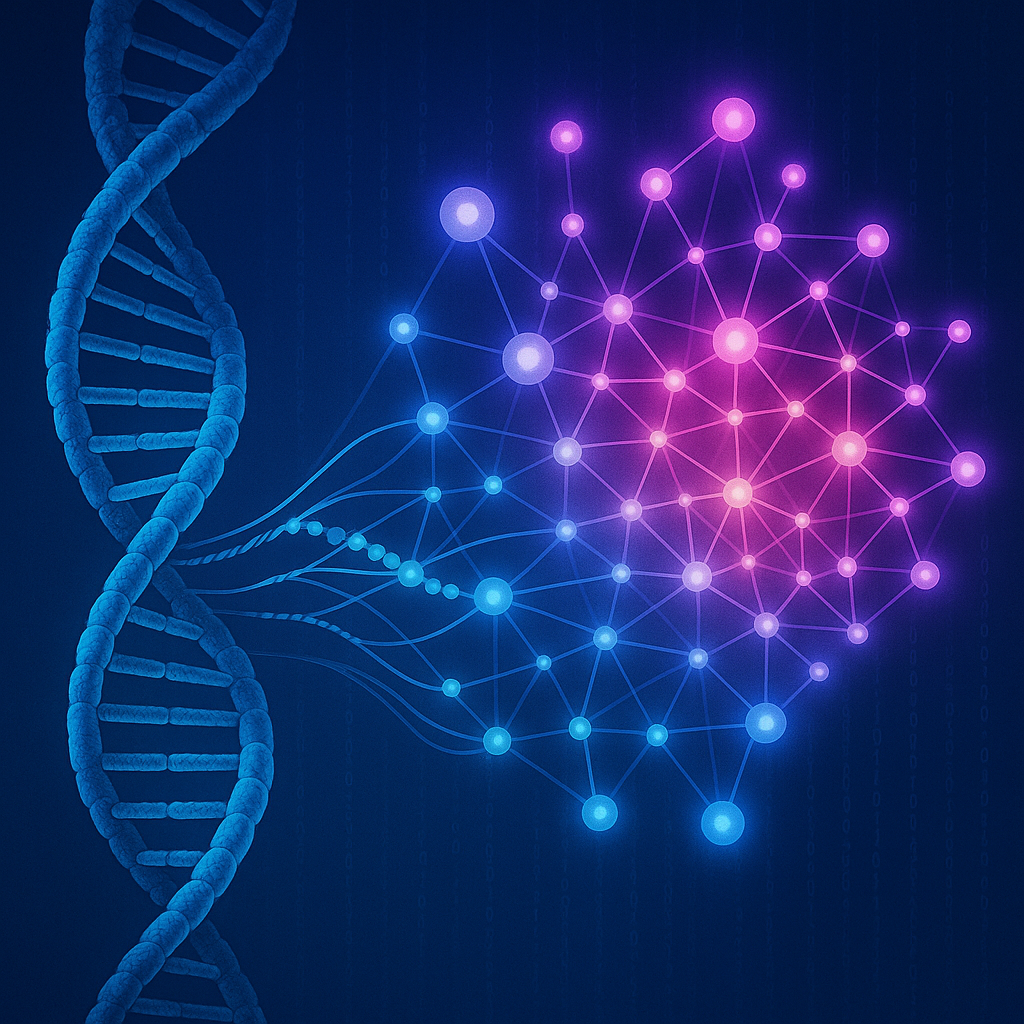
We are excited to share that we have recently published a new article in Environmental Epigenetics, where we introduce the groundbreaking concept of Epigenetic Intelligence. In this work, we explore the idea that epigenetic mechanisms can be seen as a form of biological learning. Much like artificial intelligence, they have the ability to integrate memory, adaptation, and responses to the environment.
Our proposal is inspired by neuro-symbolic AI. We imagine the epigenome as a system where some components act like stable symbolic signals, while others behave in a more flexible and probabilistic way. This combination makes it possible for cells to “think,” balancing inherited memory with the capacity to adapt dynamically to change.
We believe this perspective opens new directions in many fields. In biomedicine, it could improve our understanding of how lifestyle and environmental exposures influence health, and even help us develop predictive tools for individuals and communities. In artificial intelligence, it offers a biological model for building systems that are both stable and adaptive. And in evolutionary biology, it highlights the epigenome as a learning machine, capable of maintaining memory while generating innovation.
This work, entitled “When Cells Think: A Neuro-Symbolic View of Epigenetic Regulation” has now been published in Environmental Epigenetics. You can read the full article here: https://doi.org/10.1093/eep/dvaf022.